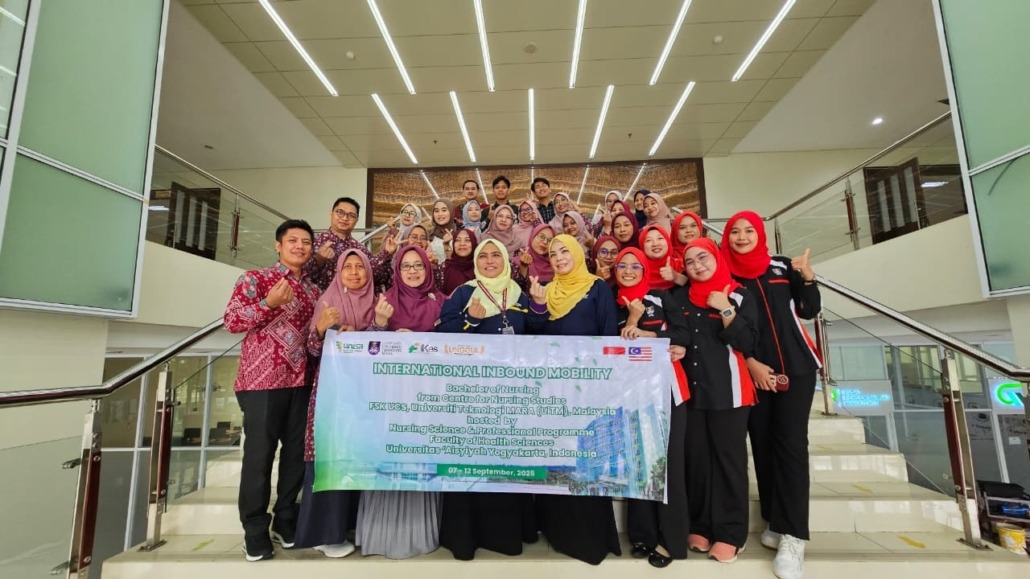
An international atmosphere returned to Universitas ‘Aisyiyah (UNISA) Yogyakarta with the arrival of a delegation from Universiti Teknologi MARA (UiTM) Malaysia. Seven students and two accompanying lecturers will participate in the five-day “International Inbound Mobility” program, which runs from Monday (September 8) to Friday (September 12).
This program is designed to provide a comprehensive learning experience. Participants will not only study in the classroom, but will also go out into the field to observe nursing practices in Indonesia. An exciting agenda has been prepared, including a hospital visit to PKU Muhammadiyah Gamping and a community service program at SMK Negeri 2 Godean.
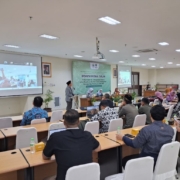
The Deputy Dean III of the Faculty of Health Sciences at UNISA Yogyakarta, Wantonoro, Ph.D., warmly welcomed the UiTM delegation. He stated that this collaboration will be a two-way partnership.
“Welcome. Among many universities, UNISA Yogyakarta was chosen. Next year, it will be our turn to send students to UiTM in the same program, not only from the nursing department,” said Wantonoro.
In between academic activities, UiTM students will also be taken on a tour to learn about the rich culture of Yogyakarta. Ts. DR. Sharifah Shafinaz binti SH Abdullah, one of the accompanying lecturers from UiTM, explained that their main objective is to study nursing science while gaining hands-on experience in Indonesian hospitals.
This visit is expected to be the beginning of broader collaboration, not only limited to student exchanges, but also extending to joint research and scientific publications for the development of nursing science in both countries.
https://www.unisayogya.ac.id/en/wp-content/uploads/sites/16/2025/11/image-6.jpeg5791030adminhttps://media.unisayogya.ac.id/wp-content/uploads/2024/01/Logo-Unisa_Horisontal_bg_putih.pngadmin2025-11-03 16:26:532025-11-03 16:26:54Malaysian Students Study Nursing and Culture at UNISA Yogyakarta
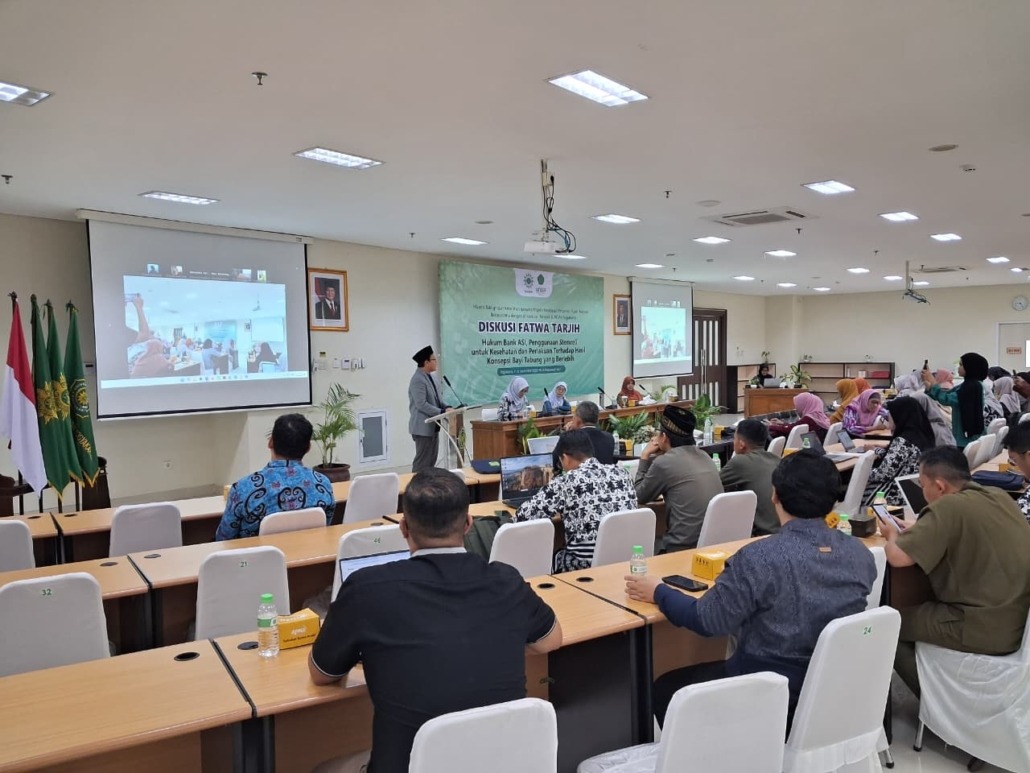
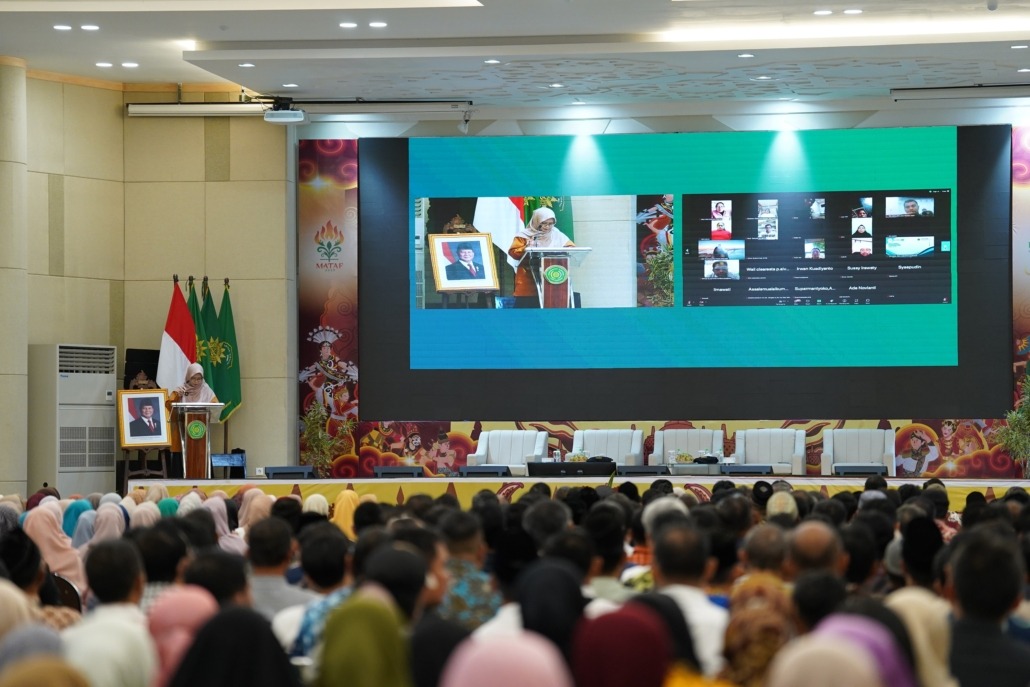
Along with the rapid development of health technology, various crucial questions have arisen that require answers from a Sharia perspective. Responding to this challenge, the Central Leadership (PP) of ‘Aisyiyah took an important step by holding a Tarjih Fatwa Discussion on three pressing issues: the law on breast milk banks, the use of stem cells for health, and the treatment of embryo remains from IVF programs.
The event, initiated by the Tabligh and Ketarjihan Council and the Health Council of PP ‘Aisyiyah, took place at ‘Aisyiyah University (UNISA) Yogyakarta on September 11-12, 2025. The discussion aimed to provide legal certainty and guidance for Muslims in Indonesia.
UNISA Yogyakarta Rector Dr. Warsiti, S.Kp., M.Kep., Sp.Mat., emphasized the relevance of this discussion in her opening remarks. She cited her university’s desire to establish a stem cell laboratory, which raises fundamental questions about its permissibility in Islam.
“We want to have a stem cell laboratory, and then the question arises whether this is permissible according to the fatwa council on stem cells,” said Warsiti.
Meanwhile, Secretary of the Tarjih Council of PP Muhammadiyah, Muhamad Rofiq Muzakkir, Lc., M.A., Ph.D., explained that these modern issues are very complex and cannot be answered by one expert alone. Therefore, Muhammadiyah and ‘Aisyiyah always prioritize collective ijtihad.
“Ijtihad must be carried out in an interdisciplinary manner, combining various expertise in fiqh and dalil,” said Muzakkir.
The discussion, officially opened by the Chairperson of the Central Board of ‘Aisyiyah, Dr. Apt. Salmah Orbayinah, M.Kes., was attended by 96 participants from across Indonesia in a hybrid format. The outcomes of this discussion are highly anticipated as fatwas that will serve as concrete guidelines for the community.
https://www.unisayogya.ac.id/en/wp-content/uploads/sites/16/2025/11/image-5.jpeg7731030adminhttps://media.unisayogya.ac.id/wp-content/uploads/2024/01/Logo-Unisa_Horisontal_bg_putih.pngadmin2025-11-03 16:18:092025-11-03 16:18:11Thoroughly Examining the Law on Breast Milk Banks and Stem Cells, ‘Aisyiyah Holds Fatwa Discussion at UNISA Yogyakarta
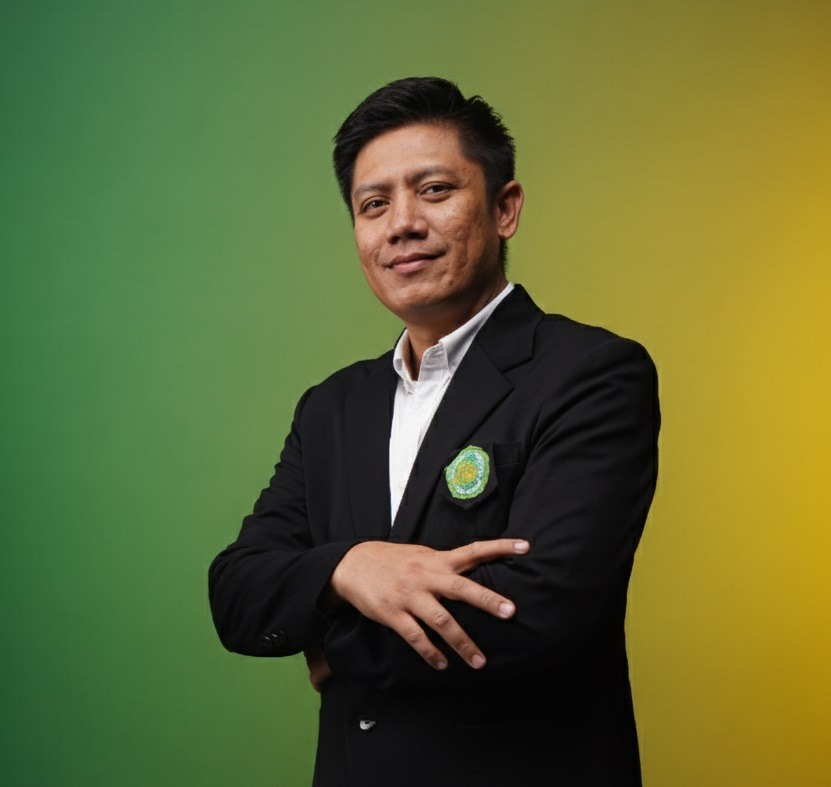
Universitas ‘Aisyiyah (UNISA) Yogyakarta has once again made itself proud through one of its outstanding lecturers, Wantonoro, M.Kep., Sp.Kep.MB., Ph.D., who has successfully created two innovative works in the field of health and nursing. Known for his creativity, Wantonoro developed the Squeeze Ball with a Squeeze Recording System (ID S000010052) as a rehabilitation therapy tool to support patient recovery, and the Elimination Assistance Chair for Hip Fracture Recovery Patients (ID S000006958), which provides a practical solution for patient comfort and independence.
These two works are not merely products, but tangible contributions by Wantonoro to improving the quality of healthcare services. In addition to innovating, he is also actively writing international scientific publications on topics such as palliative care, the quality of life of the elderly after hip fracture surgery, the role of family in diabetes wound care, and emotional support for hemodialysis patients. His works not only enrich nursing science but also serve as important references for healthcare practitioners in Indonesia and around the world.
Wantonoro’s long journey in the academic world is full of ups and downs. From his master’s degree, specialist program, to his Ph.D., he went through each process with perseverance and consistency. “For me, every step in education is proof that sincerity will not betray the results. I hope this story can inspire students not to give up easily in achieving their dreams,” he said.
In closing, Wantonoro advised students and the younger generation to always strive for progress in everything they do. “What has been started must be completed properly. That is the form of responsibility and commitment that will lead us to great achievements,” he said.
With the achievements he has attained, Wantonoro has not only brought honor to his name but also become a great source of pride for UNISA Yogyakarta as a university that continues to support the emergence of innovation and tangible contributions in the field of health.
Emotion and pride enveloped the parents of new students at Universitas ‘Aisyiyah (Unisa) Yogyakarta. They admitted that they not only entrusted their children’s academic education to the university, but also entrusted their sons and daughters to be cared for with great attention. Parents from various regions gave positive impressions of this year’s new student admissions, while the university emphasized its commitment to producing an outstanding generation.
One parent from Gorontalo, Yusuf Khalib, recounted his child’s struggle to enter Unisa Yogyakarta. He said that his child had applied to Unisa Yogyakarta twice, and this year was successfully accepted into the desired study program. He also appreciated Unisa Yogyakarta’s excellent reception from the start.
“My child was accepted into Anesthesiology. We hope that the faculty members can educate our child to become a professional anesthesiologist. We know that at Unisa Yogyakarta, our child is not only educated but also nurtured,” said Yusuf during the New Student Parent Meeting at Unisa Yogyakarta’s Convention Hall on Saturday (September 13, 2025).
The parents of one of the new psychology students, Nirmala Deti, also had a good impression of Unisa Yogyakarta from the moment they arrived. “For us Sumatrans, it’s been a wonderful experience. To this day, thank God, we are very confident in entrusting our child here. Our child not only gains knowledge but is also cared for,” said Nirmala.
Nirmala mentioned that she feels more at ease leaving her child at Unisa Yogyakarta. This is because the lecturers also treat the students as their own children. “At first, we were a bit hesitant, as she is our daughter and our youngest child, but because the lecturers treat our child as their own, we can be at ease and have peace of mind,” she said.
The Rector of Unisa Yogyakarta, Warsiti, stated that Unisa Yogyakarta accepts all segments of society, not just the upper class. This is reflected in the availability of scholarships for academically outstanding students who are economically disadvantaged. “Unisa Yogyakarta is here not just for certain groups, but for everyone,” said Warsiti.
Although open to all groups, Unisa Yogyakarta remains strict in selecting students. This year, out of a total of 12,331 applicants, 2,508 new students were accepted. The students accepted at Unisa Yogyakarta come from various regions in Indonesia, and some even come from abroad.
“It was not an easy struggle, but your sons and daughters have become winners, having fought hard to win at Unisa Yogyakarta. There are students from abroad, Thailand, Timor Leste, Ghana, Sudan, Nigeria,” said Warsiti.
The trust of parents and new students is also inseparable from Unisa Yogyakarta’s achievements so far. Especially now that Unisa Yogyakarta has been accredited as Excellent, which proves the quality of Unisa Yogyakarta. “Alhamdulillah, in less than 8 years, Unisa Yogyakarta has been accredited as an Excellent institution,” said Warsiti.
Supriyatiningsih, a member of the Unisa Yogyakarta Board of Trustees (BPH), noted that Unisa Yogyakarta has established collaborations not only domestically but also internationally, including with developed countries like Germany. She hopes that graduates from Unisa Yogyakarta will also be able to make a name for themselves and represent Unisa Yogyakarta and Indonesia on the global stage.
Supriyatiningsih said that the university would support students in achieving their dreams. “We also ask for the support of parents. Once they have entered the ‘fast track’, we will open the door for them. God willing, the BPH will discuss with the rectorate the possibility of free tuition,” she said.
During the event, there was also a dialogue session with Ratna Yunita Setiyani Subardjo, a psychology lecturer at Unisa Yogyakarta. Ratna discussed the role of parents in building an excellent generation.
https://www.unisayogya.ac.id/en/wp-content/uploads/sites/16/2025/11/image-3.jpeg6871030adminhttps://media.unisayogya.ac.id/wp-content/uploads/2024/01/Logo-Unisa_Horisontal_bg_putih.pngadmin2025-11-03 15:59:522025-11-03 15:59:54The Joy and Pride of Parents of New Students at UNISA Yogyakarta
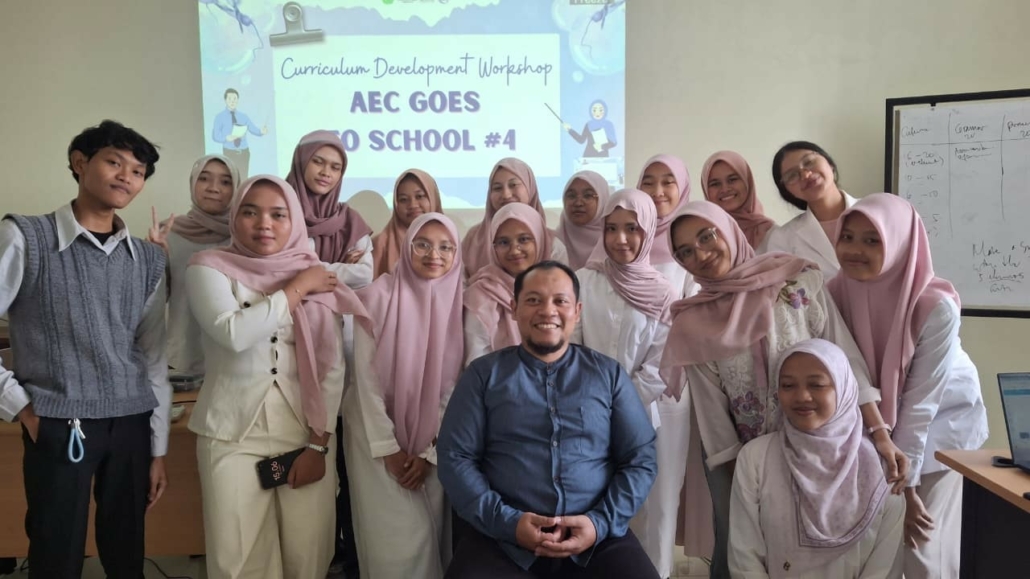
The ‘Aisyiyah English Club (AEC) Student Activity Unit (UKM) at ‘Aisyiyah University (Unisa) Yogyakarta is once again presenting an innovation in its community service program through the AEC Goes to School #4 activity. This activity, officially launched for the 2025/2026 period, demonstrates the dedication of Unisa Yogyakarta students in contributing to education while introducing the campus to the secondary school community.Through AEC Goes to School #4, Unisa Yogyakarta students not only hone their leadership, communication, and teaching skills, but also participate in the campus’ mission to make a real contribution to society. This program is expected to serve as a bridge that strengthens the relationship between Unisa Yogyakarta and its partner schools, while also inspiring the younger generation to master international languages.“We are proud to be able to contribute directly to increasing interest in learning English among high school students. This program not only benefits them but also us as students because we can learn to teach while introducing Unisa Yogyakarta more widely,” said one of the AEC student club administrators, Dea Amalia, on Saturday (September 13, 2025).
AEC is a platform for developing English language skills for Unisa Yogyakarta students, consistently offering a variety of educational activities. One of these is AEC Goes to School, a community service program that sends tutors to partner schools to introduce English using creative, interactive, and fun methods.
From Batch 1 to 3, the program focused on kindergarten children, using a play-based learning approach to foster an interest in English from an early age. However, in the 2025/2026 period, AEC Goes to School underwent a major transformation. The program now targets high school students, with SMAN 1 Gamping as the target school. The main participants of this activity are students who are members of the school’s English Club.
https://www.unisayogya.ac.id/en/wp-content/uploads/sites/16/2025/11/Screenshot-2025-11-03-154813.png352633adminhttps://media.unisayogya.ac.id/wp-content/uploads/2024/01/Logo-Unisa_Horisontal_bg_putih.pngadmin2025-11-03 15:51:042025-11-03 15:51:20AEC Unisa Yogyakarta Strengthens English Literacy Among the Younger Generation