Webinar Internasional 1030x684

International Webinar

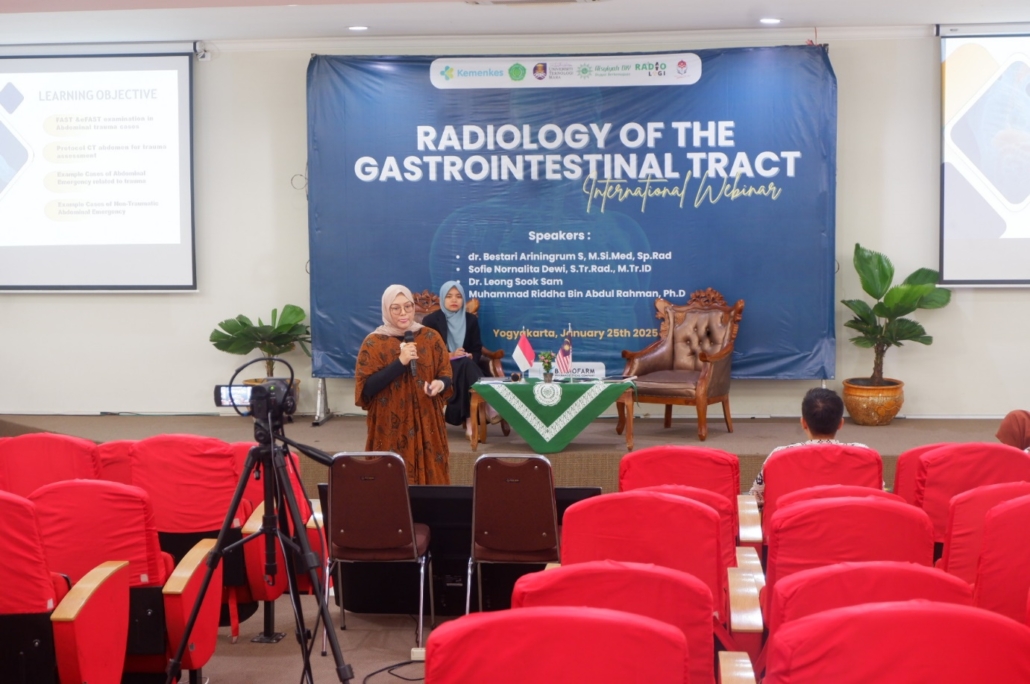
The Radiology Study Program of the Diploma III Program of the Faculty of Health Sciences (FIKes) of Universitas ‘Aisyiyah (UNISA) Yogyakarta successfully held an international webinar entitled “Gastrointestinal Radiology”, Saturday (25/1/2025). This event was the result of collaboration with the Health Assembly of the Central Leadership of ‘Aisyiyah Yogyakarta Special Region and Universiti Teknologi MARA Malaysia.

International Webinar

This international webinar presented four expert speakers in the field of radiology, both from Indonesia and Malaysia, namely Sofie Nornalita Dewi, S.Tr. Kes., M.Tr.ID (Lecturer at UNISA Yogyakarta), dr. Bestari Ariningrum Setyawati, M.Si., Med. Sp. Rad. (Radiology Specialist at dr. Sardjito Hospital), Leong Sook Sam (Lecturer at Universiti Teknologi MARA), Muhammad Riddha Bin Abdul Rahman, Ph.D. (Lecturer at Universiti Sultan Zainal Abidin).

The chairman of the International webinar committee, Mohammad Zaim, S.Si., M.Sc., said that this event was attended by 613 participants from Indonesia and Malaysia. Participants consisted of various groups, including radiographers, radiology specialists, general practitioners, nurses, medical physicists, internal medicine specialists, and students from both countries.

Wantonoro, S.Kep., Ns., M.Kep., Sp. Kep. MB., Ph.D as Vice Dean III of FIKes for Student Affairs and Alumni of UNISA Yogyakarta expressed his appreciation to all participants and the committee for the successful organization of this webinar. He hopes that through this webinar, participants’ knowledge about gastrointestinal radiology can increase, and there will be useful interactive discussions between participants and speakers.

This international webinar event ran well and smoothly from morning to evening. Despite being held online, all participants showed great enthusiasm in attending each session and actively participating in the discussions guided by the moderator.

At the end of the event, the host, Ms. Setya announced the winners of the International “SACRUM” poster and video competition organized by the Radiology Student Association (HIMARA) UNISA Yogyakarta.
Hari Jadi 1 1030x646

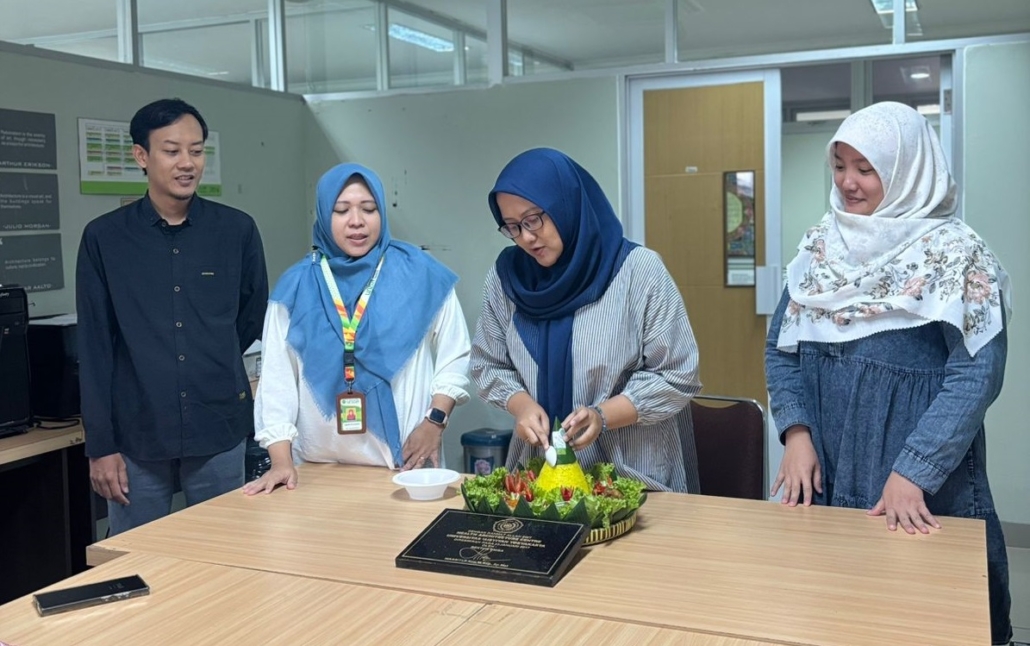
The Health Architecture Center (HAC) of Universitas ‘Aisyiyah (UNISA) Yogyakarta celebrated its 8th anniversary on January 23, 2025. Established in 2017, HAC Unisa has become a center for architectural studies that focuses on research and innovative solutions in the field of health architecture.

In commemoration of its anniversary, HAC UNISA would like to express its deep gratitude for the support from various parties, including UNISA Yogyakarta, colleagues, and strategic partners.

HAC UNISA was established by the Architecture Study Program of UNISA Yogyakarta as a form of commitment to develop research-based architectural knowledge and practice. This study center has a main focus on health architecture, with the aim of creating a healthy and sustainable environment.

“Entering HAC UNISA’s one-year anniversary, we are strengthening our operational foundation and future targets,” said Aprodita Emma, Director of HAC Unisa.

Aprodita also added that several accelerated programs will be carried out in the future, such as the waqf design of mosques, both for Muhammadiyah-Aisyiyah autonomous organizations and the general public.

The mosque and mushola design waqf initiative is one of HAC UNISA’s flagship programs in order to make a real contribution to society. This program aims to provide quality architectural designs that meet the needs of the community, especially in the construction of places of worship.

“We hope that with the support from internal and partners, we can further strengthen HAC and spread more benefits,” continued Aprodita.

For eight years, UNISA HAC has contributed to the development of health architecture in Indonesia. Various research and innovative projects have been produced by the center, with the aim of creating a healthy and comfortable environment for the community.

HAC UNISA is also involved in various seminars, workshops and training activities related to health architecture. This aims to increase the public’s knowledge and understanding of the importance of architecture in creating a healthy environment.

At the age of 8, HAC Unisa has great hopes to continue to grow and make a greater contribution to society. With the support of various parties, HAC Unisa is confident that it can achieve the goals that have been set.

Hari Jadi 1 1030x646

Tags: aisyiyahbanggamenjadiunisabeunisahari jadiunisayogya

Reakreditasi 1030x773

The Nutrition Study Program of the Faculty of Health Sciences (FIKes) of Universitas ‘Aisyiyah (UNISA) Yogyakarta received a visit from a team of assessors from the Institute for Self-Accreditation of Higher Education in Health (LAMPT-Kes) on Friday (31/1/2025). This visit is part of the reaccreditation process of the nutrition study program which aims to ensure the quality and standard of education provided.

The field assessment was held in the 4th floor courtroom of the Siti Moendjijah building and was attended by two assessors from LAMPT-Kes, namely Dr. Ahmad Faridi, SP, MKM, C.IP, C.TM and Dr. Muflihah Isnawati, DCN, M.Sc. Both were tasked with conducting data checks and interviews with UNISA Yogyakarta students and stakeholders.

The Rector of UNISA Yogyakarta, Dr. Warsiti, S.Kp., M.Kep., Sp.Mat, in her speech expressed her full support for the reaccreditation process. She also hoped that all the efforts made can bring UNISA Yogyakarta Nutrition Study Program to be superior, more qualified, and able to play an active role in improving public health.

“Hopefully all the efforts we make today will lead us to an excellent nutrition study program, increasingly qualified and able to play an active role in improving public health,” said Warsiti.

Meanwhile, Dr. Ahmad Faridi explained that his task in this field assessment was to validate and verify the data and evidence that had been sent by the Nutrition Study Program to LAMPT-Kes. He also emphasized the importance of cooperation from all relevant parties to prepare the data needed by the assessors.

“We only need cooperation from all parties here to prepare what is needed by the assessors, namely in the form of data that we need to see is appropriate,” said Faridi.

The results of this field assessment will be the basis for LAMPT-Kes to determine the accreditation status of UNISA Yogyakarta’s Nutrition Study Program. This accreditation is important to ensure the quality of education and graduates of the Nutrition Study Program, as well as to give confidence to the public that this study program meets the standards that have been set.

Tags: aisyiyahbanggamenjadiunisabeunisareakreditasiunisayogya

Demam Berdarah 1030x623

The ongoing rainy season brings a variety of impacts, from benefits for the agricultural sector to challenges in public health. One disease that often becomes a major concern during this season is Dengue Fever (DHF). This disease poses a serious threat every year, especially in tropical regions like Indonesia. High humidity and stagnant water caused by rain create an ideal environment for breeding Aedes aegypti mosquitoes, the main vector of dengue virus spread.

Stagnant water that forms in various places, ranging from gutters, open water containers, to used objects such as cans or old tires, becomes a place for mosquitoes to lay eggs. Female Aedes aegypti mosquitoes only need a small amount of water to lay their eggs, which will then hatch into larvae within a few days. The mosquito’s rapid life cycle means its population can increase dramatically during the rainy season, increasing the risk of dengue transmission.

The spread of the dengue virus occurs when an infected mosquito bites a human. The virus enters the bloodstream through the mosquito’s saliva and begins to replicate in the body. Symptoms of DHF usually appear within four to ten days after the bite, characterized by high fever, severe headache, joint pain, and red spots on the skin. In more severe cases, the disease can cause plasma leakage, bleeding, and even death if not treated immediately.

The rainy season also extends the life span of mosquitoes. The high humidity during this season provides ideal conditions for mosquitoes to remain active in biting and spreading the virus. Not only outdoors, Aedes aegypti mosquitoes can also breed inside the house, especially in uncovered or not regularly drained water containers, such as bathtubs, dispensers, and pet drinking places.

This situation is exacerbated by people’s low awareness of the importance of keeping the environment clean. Many people do not realize that even small puddles can serve as breeding grounds for mosquitoes. In addition, the habit of piling up garbage or leaving used items around the house without being properly managed also increases the risk.

Global climate change is also affecting the pattern of dengue spread. Warmer temperatures and more frequent rainfall create a longer rainy season cycle. This allows mosquitoes to breed more and accelerates the cycle of dengue virus spread. The combination of climate change and lack of effective prevention measures has caused the number of dengue cases to increase every year in many areas.

The government and various health institutions have taken steps to minimize the risk of dengue spread. A mosquito nest eradication program that involves the community is one of the main efforts to reduce the mosquito population. Fogging is also conducted in areas with high cases to kill adult mosquitoes. However, the success of this program is highly dependent on the active participation of the community.

In addition, education on the importance of maintaining environmental cleanliness must continue to be promoted. People need to understand that prevention is more effective than treatment. Recognizing the early symptoms of DHF and seeking immediate medical attention is also key to reducing the severity and mortality of the disease.

However, government efforts are not enough without the full support of the community. Each individual has an important role in preventing the spread of DHF, especially by maintaining a clean environment around the house. By regularly cleaning up standing water, covering water containers, and recycling used items, we can break the life cycle of the Aedes aegypti mosquito.

Demam Berdarah 1030x623

Author: Wawan Febri Ramdani Nursing Lecturer at ‘Aisyiyah University Yogyakarta

Simulasi Bencana 2 1030x579

Disaster Simulation 2

The Nursing Study Program of Universitas ‘Aisyiyah Yogyakarta (UNISA) held an earthquake disaster management simulation involving 232 final year students. This activity aims to improve the technical competence and mental readiness of students in dealing with disaster emergency situations, Saturday (25/01).

This simulation is part of the Disaster Nursing course and is carried out in collaboration with various parties, including the UNISA Center for Women, Family and Disaster Studies (PSPKB), the DIY Regional Disaster Management Agency (BPBD), and the DIY Social Service (TAGANA).

The Dean of UNISA Yogyakarta’s Faculty of Health Sciences, Dr. Rokhana Dewi, SSiT, MPH, opened the event by emphasizing the importance of training for death students in facing disaster challenges.

“This training equips students to become resilient, competent, and responsive health workers,” said Dewi.

Head of the Nursing Study Program at UNISA Yogyakarta, Dr. Sarwinanti, S.Kep., Ns., M.Kep., Sp.Mat., added that this simulation not only trains technical skills, but also builds students’ character to be able to work in teams and make quick decisions under pressure.

The simulation was guided by a team of lecturers who are experts in emergency and disaster management, namely Wawan Febri Ramdani, S.Kep., Ns., M.Kep., Dwi Prihatingsih, S.Kep., Ns., M.Ng., Efi Fibriyanti, S.Kep., Ns., M.NS., as well as Abdul Aziz, Enaryaka and others. They assisted students in a large earthquake scenario that caused infrastructure damage and many casualties.

Students were divided into several teams with their respective roles, such as the Rapid Health Assessment (RHA) Team, Field Hospital Team, Emergency Medical Team (EMT), and Support Team. Each team has a specific task in handling emergency situations, from initial assessment to evacuation of victims.

This simulation is designed with a high level of realism, using properties and medical equipment that resemble real conditions in the field. It aims to provide hands-on experience to students, so that they can feel the pressure and challenges that arise in disaster situations.

Dewi emphasized that this activity is a form of UNISA’s commitment to support government programs in disaster risk reduction. She hopes that this activity can provide direct benefits for students, both during their studies and when they enter the community as health professionals.

Tags: aisyiyah, banggamenjadiunisa, beunisa, simulasi bencana, unisayogya